
The Best SaaS PPC Agencies

There are five names here and we make one of them, so read the list with that in mind. Four are agencies that genuinely specialise in B2B software, and the fifth is Atlas, our own product, which is not an agency at all. Top means notable rather than ranked by quality, because nobody has run a fair contest between these firms.
Everything below about the other four was read off that firm’s own website on 15 September 2026. We never link to a competitor, so claims are attributed in plain text. One thing is worth knowing before the first call: none of the four publishes what it charges.
The short version
- The SaaS Ads Studio, with Atlas: for a lean B2B SaaS team that wants the account built and run without a retainer.
- Directive: for a software company that wants paid search sitting inside a wider performance programme.
- Hey Digital: for a SaaS company with product-market fit that wants paid search, paid social and ad creative from one specialist team.
- Powered by Search: for an established B2B business ready to commit to a year and treat paid as one layer of a demand system.
- Refine Labs: for mid-market and enterprise B2B tech at Series B and beyond, with brand and demand run as one motion.
Atlas, by The SaaS Ads Studio
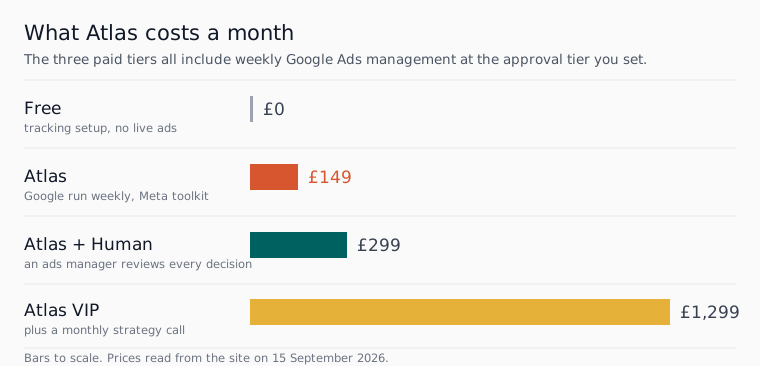
Atlas is not an agency, which is the reason it sits first rather than any verdict about quality. It connects to your own Google Ads account, builds the full structure in hours, and then manages Google week after week at an approval tier you choose. Rob Walling of MicroConf described it as an agency team in a box, and that is the shape of the thing.
Google and Meta are not the same job and we will not blur them. On Google, Atlas applies weekly changes at your approval tier. On Meta, Atlas builds the campaigns and then ships weekly tools you run yourself in a few minutes, because there is no Meta Marketing API behind it. The Google Ads for SaaS page and the Facebook side of the product set out each one.
The rails matter more than the speed. Atlas never blocks a converting search term, adds at most 30 negative keywords and 5 broad match keywords a day, always creates campaigns paused, and anything it changes can be undone within 30 days. You set the approval tier and you keep the account.
Why They’re a Good Choice
- Trained on £10M of real SaaS ad spend, which is where the playbooks come from, so the keywords and ad copy reflect how software buyers search.
- Weekly management on Google at the price of a tool rather than a retainer, with you approving the work.
- Safety rails that are specific and published, instead of a promise to be careful.
- Built for SaaS funnels only: trials, demos, pricing-page visitors and offline conversions.

Directive
Directive is the largest name on this list and the one most likely to be on your shortlist already. Its PPC page, read on 15 September 2026, describes paid search across Google Ads and Microsoft Advertising, with search demand modelling, intent-led campaign structure, search term management, landing page work and offline conversion tracking as named parts of the service.
What marks it out is the measurement language. Directive says it judges paid search on sales acceptance, opportunity creation, cost per opportunity, pipeline contribution and revenue rather than clicks and cost per lead. The same site lists a startup package alongside full retainers, and offices in Orange County, Austin, New York City, Mexico City, London and Toronto.
The honest limitation is scope. Directive is a multi-division agency covering content, programmatic, revenue operations, PR and paid social as well as search. A two-person team that needs one Google Ads account cleaned up is buying a small slice of something built much larger. Our Directive Consulting comparison goes through the trade.
Why They’re a Good Choice
- Paid search and Microsoft Advertising run by specialists who work on B2B accounts all day.
- Reporting framed around pipeline and cost per opportunity, which is the conversation your board is having.
- A named methodology and a startup package, so there is more than one way in.
- Offices in six cities including London, if you want time-zone overlap.
Hey Digital
Hey Digital works only with B2B SaaS and says so plainly. Its PPC page, read on 15 September 2026, describes paid search, paid social and display run as a single system by a team that has worked on more than 200 SaaS accounts, across LinkedIn, Google, Meta, YouTube, Microsoft Bing, Reddit, Capterra and G2.
The method is published as five phases, opening with an audit of campaign structure, search term reports, negative keyword coverage, bid strategies and conversion tracking, and closing with optimisation and revenue reporting. Creative is made in house rather than subcontracted. The company trades as Hey Digital OÜ, per its own footer.
The limitation is one Hey Digital publishes itself, which is to its credit. Its fit check says the agency is probably wrong for you if you are pre product-market fit, still defining your ICP, after a one-month test, or wanting one supplier for SEO, content and email as well. It is a paid specialist, not a marketing department. We set out the Hey Digital comparison separately.
Why They’re a Good Choice
- B2B SaaS only, so the playbooks come from software accounts rather than a general roster.
- Paid search, paid social and creative under one roof, with a senior strategist as the contact.
- A published five-phase process that starts with an audit rather than a rebuild.
- An honest fit check on their own site that rules people out, which saves everybody a call.

Powered by Search
Powered by Search sells paid media as one layer of a demand system rather than as a standalone service. Its paid ads page, read on 15 September 2026, covers Google Ads, LinkedIn and Meta for SaaS, technology, services and manufacturing companies, and says the team has tested and scaled campaigns for more than 70 B2B companies.
One detail is worth more than the positioning, and it is the fee model. The site states there are no ad buy fees and no performance payments, and that you keep billing for your own ad accounts while the agency bills only its fee.
The limitation is the commitment, and again they publish it. Their stated good fit is a B2B company ready to put a minimum of 7,500 US dollars a month into marketing for a minimum of one year, with strong product-market fit already in place. Our Powered by Search comparison covers who falls on each side of that door.
Why They’re a Good Choice
- A flat fee with no percentage of ad spend, so the incentive is not to spend more of your money.
- You keep control of ad account billing, which makes leaving cleaner than it usually is.
- Comfortable across Google, LinkedIn and Meta rather than search alone.
- Paid sits next to SEO, content, ABM and RevOps when a single channel is not the constraint.
Refine Labs
Refine Labs is the furthest from a pure PPC agency here and the clearest about who it is for. Its site, read on 15 September 2026, says it works with B2B tech companies at Series B and beyond, and that it has helped hundreds of mid-market and enterprise B2B tech companies since 2019.
The model is Brand, Demand and Expand run as one motion rather than three. Paid media covers LinkedIn, Google, YouTube, Meta, connected TV and out of home, and the site makes a point that the people who build the strategy also run the media. Engagements open with a six-week foundation sprint that audits the current setup before anything is rebuilt.
The limitation follows from the positioning. If broad match is eating the budget and nobody has read the search term report since spring, this is a large answer to a small question, and the stage requirement rules out most companies reading this. It is the right call when paid search is fine and the demand behind it is not. The Refine Labs comparison has the longer version.
Why They’re a Good Choice
- Strategy and execution sit with the same people, so nothing is lost in a handover.
- Channels well beyond search, including connected TV and out of home, for companies at that scale.
- A six-week diagnostic opening rather than an immediate rebuild.
- Unusually explicit about the stage it serves, which makes self-selection easy.

How to choose between the five
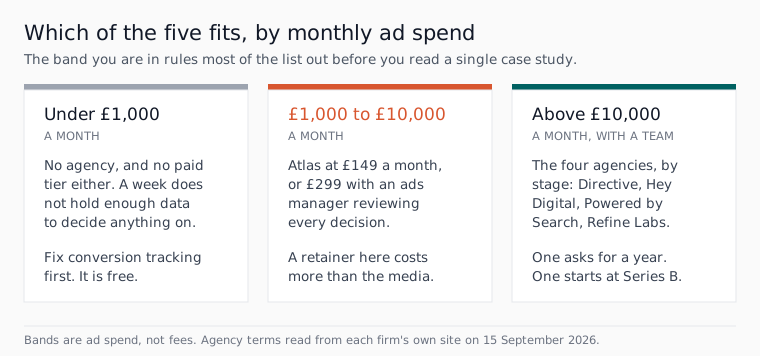
Start with your monthly ad spend, because it rules most of this list out before you read a single case study. Below about a thousand pounds a month, hire nobody: a week does not hold enough data to judge a keyword. In the band above that, an agency retainer usually costs more than the media it manages, which is the gap Atlas was built for. Higher again, with a marketing team in place, the four agencies become sensible.
Then sort by what is actually broken. If the account is wasteful, you want search term discipline and negative keyword hygiene. If the account is clean and the pipeline is still thin, the problem is demand or positioning, and no amount of bid management fixes it. Hiring a demand generation partner to solve a broad match problem is the most expensive mistake in this category.
Three questions worth asking on the first call
Ask who will actually touch the account, and how often. Agencies sell senior strategists and staff the day-to-day differently, which is normal, but you want the name and the cadence before you sign. Ask what happens in week one, and listen for an audit rather than a rebuild.
Then ask the blunt one: what is the minimum term, and what do you do if it is not working by month three? A firm that publishes its fit criteria, as two of these four do, will answer without flinching. If you would rather run the audit yourself first, our search term analyser is free, and the roundup of Google Ads software for SaaS covers the tooling side of the same question.
What we would do on a modest budget
At the spend most readers of this article are at, we would not hire any of the four. The retainer would be larger than the media, the account is not complicated enough yet to need six specialists, and the thing that moves the number is weekly search term discipline that nobody needs a strategy deck to perform. That is the argument for Atlas, and it is a narrow one.
With a marketing team, a long sales cycle and a budget several times that size, the calculation flips and one of the four earns its fee. That is not false modesty, it is the same advice we would give on a call. If you are in the first camp, you can start with Atlas free and look at the account it builds before you pay anything, though the free tier does not run live ads.
Questions people ask about this
- Do SaaS PPC agencies publish their prices?
- Mostly not. Of the four agencies here, none showed a fee on the service pages we read on 15 September 2026, and only Refine Labs carries a pricing link in its main navigation. Expect a call and a custom quote. Atlas publishes its tiers, which is the easier comparison to make.
- How long will an agency tie me in for?
- It varies and it is worth asking first. Powered by Search states on its paid ads page, read 15 September 2026, that a good fit is a company ready to commit for a minimum of one year. Atlas is billed monthly and you cancel in the app when you want to.
- Will I lose my account history if I switch from an agency to Atlas?
- No. Atlas connects to your own Google Ads account through the API and builds inside it, so the history, conversion data and learning stay where they are. New campaigns are always created paused, and anything Atlas does can be undone within 30 days.
- Does Atlas run my Meta ads the way it runs Google?
- No, and we will not pretend it does. On Google, Atlas applies weekly changes at the approval tier you set. On Meta, Atlas builds the campaigns and ships weekly tools you run yourself in a few minutes. There is no Meta Marketing API integration behind it.
- What if my spend is under a thousand pounds a month?
- Then hire nobody yet. Below roughly a thousand pounds a month there is not enough data in a week to judge a keyword, let alone an agency. Get conversion tracking right, run the free tools, and revisit the question when the account has something to say.